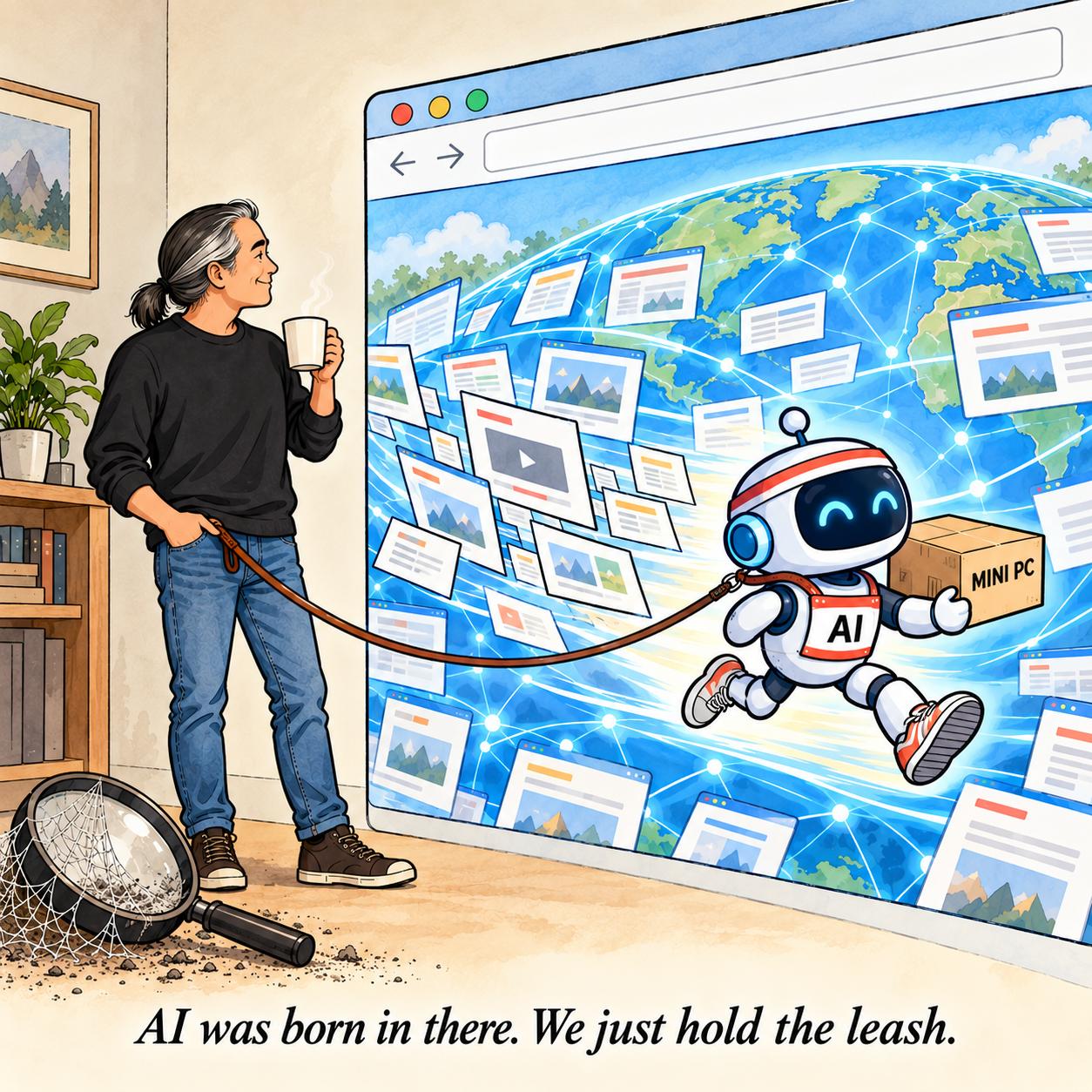
For more than two decades, Google search defined how we used the Web. Today, AI and AI agents are like Google on performance-enhancing drugs. In the days of the old Web (almost literally yesterday), Google helped you find what you were looking for. It gave you pages of links, ads, and filler you had to decipher yourself. AI reads all of that and pulls out what it thinks matters to you. AI agents can go a step further and get it done for you, like booking a reservation or filling out a form.
A great example is when I recently searched for a mini PC to replace my 15-year-old giant Dell tower. I was specific. I wanted 32GB of DDR5 RAM, a 1TB SSD, and just enough power to edit video and audio. The machine had to run two monitors over USB-C with passthrough for a USB hub. I also wanted to move my Plex media server, which holds three 8TB hard drives, onto a NAS, a small network storage box that uses less power than a full PC. A Google search for all of that returns sponsored listings and generic “best mini PCs” roundups. I described every requirement to an AI in plain sentences, and within minutes it narrowed the field to a handful of machines and compared them side by side. Yes, retailers have already started to game the system. But it’s not everywhere or pervasive… yet.
AI and LLMs didn’t happen overnight. Researchers coined the term “artificial intelligence” in the mid-1950s, and for decades most AI programs ran on rules that people wrote by hand. The field went through two major cycles of hype followed by funding collapses, in the mid-1970s and the late 1980s, which researchers call “AI winters.” In 2017, Google researchers published a design called the transformer, which became the foundation of today’s large language models, or LLMs. Google’s own researchers invented the technology that now threatens Google itself. Most people met AI for the first time when OpenAI released ChatGPT in November 2022, more than sixty-five years after the field began.
For years we called Millennials, Gen Z, and Gen Alpha “Internet natives” because they grew up with the Internet. Most of them use apps and phones without a second thought, but few can explain how a web page reaches their screen or how a computer runs a program. In 2021, The Verge reported that college professors were meeting students who didn’t understand files and folders, because they had grown up with search bars and apps that hide that structure from them. They’re natives in name only.
AI and AI agents, on the other hand, are true Internet natives. LLMs learn from enormous collections of text that companies gather from the public Web, along with books, code, and technical documentation. Their knowledge of language, and of the Web itself, comes from the Web. Developers create tools for LLMs to fetch pages, call online services, and work through websites on a person’s behalf. Engineers built them from the Internet’s text, they run on servers connected to it, and they do their work inside it, which makes them the first “being” native to it.
I put “being” in quotes because at the moment AI and AI agents are programs that can act on their own within limits that people set. Nobody knows, including the people who build them, what they are or what they might become. One day we may be able to remove the quotes. I say this because we don’t fully understand how we work either. Scientists have mapped parts of the brain, but they still can’t fully explain why you remember some things and forget others, how you arrive at a decision, or even how to define consciousness. Sounds a little like an LLM, doesn’t it?
The people who build AIs, AI agents, and LLM systems can’t fully explain them. Engineers understand the design of an LLM and the process that trains it, but they can’t trace how a model stores a concept or arrives at a particular answer across its billions of parameters. A research field called interpretability works on this problem, and it has mapped only a small part of what happens inside these models. LLMs show abilities, or what look like abilities, that their creators didn’t plan for. Researchers argue over whether those abilities arrive all at once or only look sudden because of the way tests measure them.
We’re at the beginning of AI anticipating what people want. An AI sometimes comes back with an answer that covers something I hadn’t considered or something I didn’t know to ask about. Those moments, even though they feel like magic, come from pattern recognition. AI agents that remember past conversations are starting to see your patterns on a personal level, and the more you use them, the more they learn.
We’re in control of the Internet natives right now. As long as humans build in the rules, boundaries, and limitations (thank you, Cesar Millan) to keep AI and AI agents in check, there is a future of liberation from keyboards and screens. But there is a potential fatal flaw. Humans make mistakes (I guess LLMs do too, don’t they?), and therefore mistakes are built into what we create. We’re on the precipice of something that could be wonderful, as long as we disconnect it from the systems that could destroy us.
Comments
One response to “AI and AI Agents May Be the First True Internet Native “Being””
thanks, Kevin I think lol. i did ask for this from you to explain ai to me, but its way over my head.