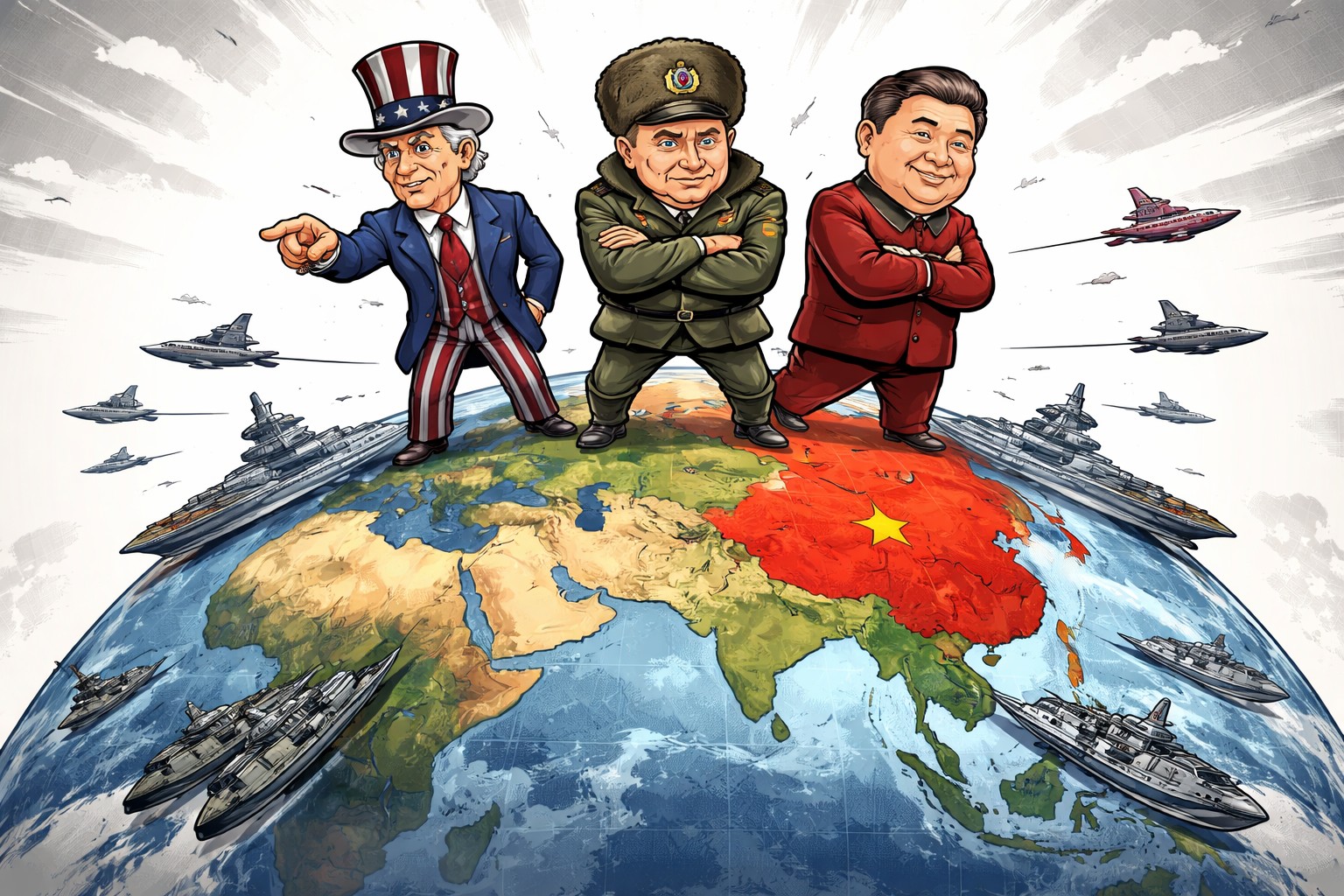
For the last few decades, the world has operated under the assumption that the Cold War ended with a single winner. The United States stood alone. That era now appears to be ending. The events surrounding Iran, and the reactions from the major powers, suggest that a tripolar world order has taken shape.
The first signal comes from Europe. In the wake of the strikes against Iran and the decapitation of its leadership, Europe has largely responded with nothing but words. Milquetoast statements on top of it. Other than Spain’s decision to block the United States from launching strikes from a base on its territory, it seems the rest of Europe decided to sit on their hands.
Even more telling is Europe’s reaction to President Trump’s requests for assistance with the Strait of Hormuz. According to reporting in the Wall Street Journal, several major U.S. allies declined to participate. Germany rejected the request outright, while Japan and Australia signaled they were unlikely to contribute vessels. Britain and France said they were merely “assessing options” and would not commit to any action before the fighting stops. Reuters also reports that Spain, big surprise, won’t be helping out in this regard either.
Europe is now feckless and almost totally without real power. They can neither stop the actions of the United States and Israel, nor are they able to impose consequences that would change the situation. The result is that Europe, despite its economic size, remains geopolitically impotent when hard power is applied.
China’s position is more complicated. The U.S. moves against both Venezuela and Iran can be viewed as indirect blows aimed at China. China is the largest buyer of oil from both countries. Restricting the flow of that oil is therefore an economic strike that forces China to adapt. China has been moving rapidly to reduce its dependence on imported fossil fuels through renewable energy expansion and the large rollout of EVs.
Chinese defense systems sold to Iran and Venezuela were quickly neutralized and failed to prevent U.S. or Israeli attacks. This might seem embarrassing for China. But this is a double-edged sword. China’s military and defense systems are not battle tested. Real-world combat provides them with valuable data to improve their systems to match ours.
For a long period after the Cold War, Russia was widely described as the “sick man of Europe.” Vladimir Putin, however, rebuilt its military capability, stabilized its economy, and leveraged its massive energy resources.
Europe’s attitude toward Russia has unwittingly pushed Russia closer to China. NATO’s steady encroachment on Russia’s western borders created allies where none existed before. Russia and China, prior to the expansion of NATO, were never very chummy. Russian strategy is now focused on strengthening ties with China as a counterweight to Western military and economic pressure. The result is the emergence of an axis of power that occupies the same continental landmass. This has huge implications for all of Europe and the balance of power across Asia.
This is now where the world sits. The United States dominates the Western Hemisphere and the North Atlantic, dragging along with it Europe as its nagging sibling that can’t get its act together. Russia has consolidated itself as the primary power across Eastern Europe. China anchors Southeast Asia and is expanding its economic and technological influence across the region. Watch out Taiwan. The Venezuela and Iran attacks either move China’s timeline up or push it back. One way or the other, this looks like a flashpoint in the near future.
Welcome to our new Tripolar World Order.
The United States, Russia, and China each now control large geographic spheres with overlapping areas of tension. Europe, ever so sclerotic, sits in between with no unified military power necessary to help shape events.