Trump’s first presidency arrived at the right moment. After eight years of slow growth and regulatory stagnation under Barack Obama, many Americans were ready for the government to loosen the shackles of control. The country’s mood was optimistic and businesses were investing. Even Trump’s critics sheepishly acknowledged that the country felt better economically than it had in years.
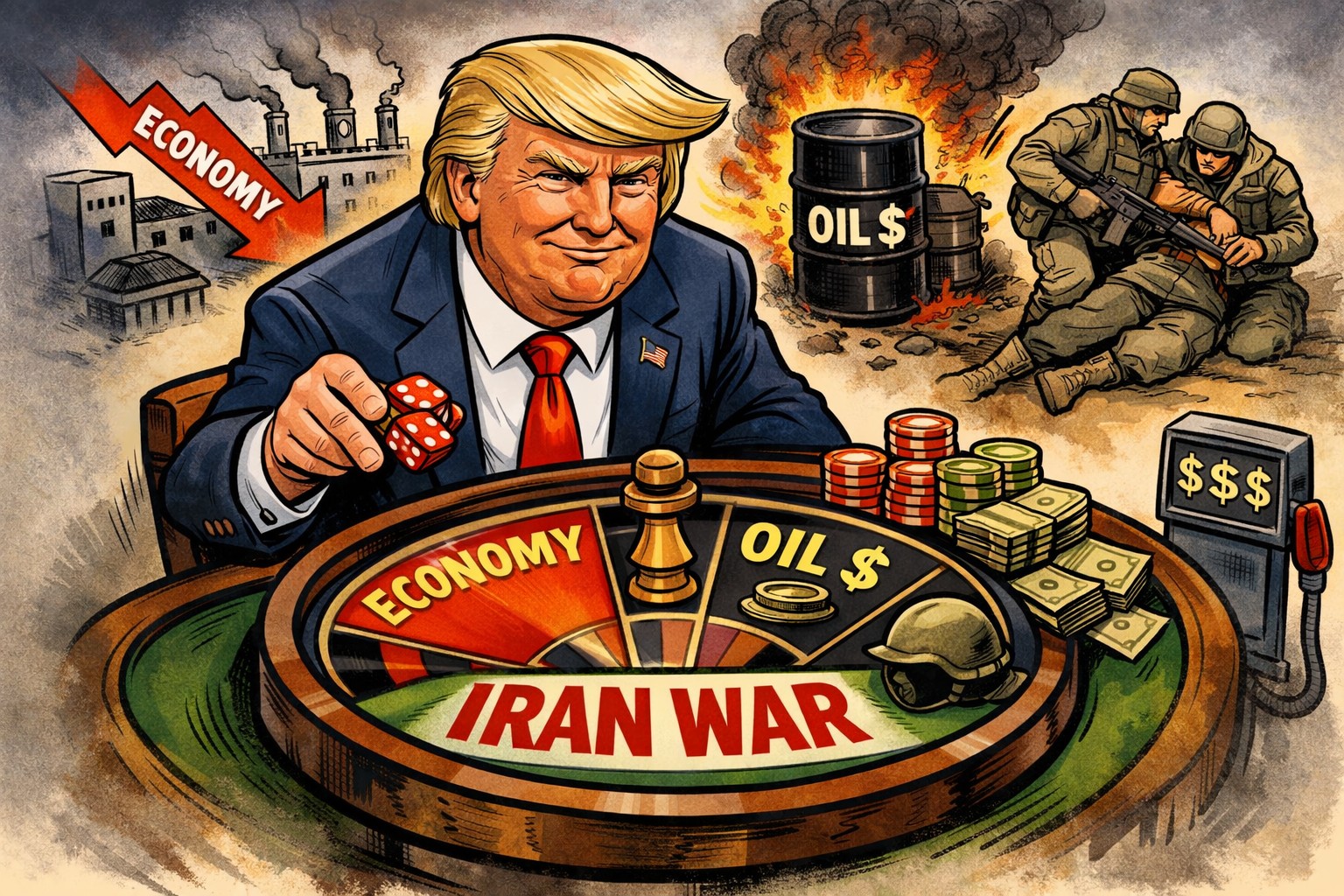
The mood in the country today is the opposite. Yes, much of today’s mood was established under President Joe Biden (aka Obama 2.0). But instead of repeating the successes of his first term, Donald Trump introduced a series of policies that kept the pressure on the U.S. economy. Tariffs created uncertainty for businesses trying to plan investment. Trump’s foreign policy involving Panama, Venezuela, Denmark, and now Iran destabilized markets. The administration is pushing a bold, global-changing agenda while the economic foundation of the U.S. is too unstable to support it.
I look at the attack on Iran in that context. Supporters of the attack argue that it’s part of a larger strategy aimed mostly at China and Russia. Iran is closely tied to both countries through energy markets, military cooperation, and other partnerships. Weakening Iran may increase pressure on China’s energy supply chains while complicating Russia’s political calculations. I can understand the need to give some pain to both China and Russia. But these decisions don’t exist in a vacuum. Energy prices immediately soared, and the risk of a prolonged war further destabilizes things. Higher energy costs affect the entire economy. Global trade, manufacturing, and food all depend on energy to produce and distribute their raw materials and goods to market. Trump was recently crowing about falling gasoline and egg prices as evidence that his economic policies were working. After the first bomb dropped, all he has left are eggs. Soon he may have egg on his face! You’re welcome for that last sentence.
Economic confidence is fragile. Employers reported the loss of roughly 92,000 jobs last month, a bad sign for the labor market. Businesses across multiple industries have slowed investment and hiring and are trying to absorb or pass along the impact of tariffs. When businesses can’t predict costs, they delay expansion and conserve cash. A brand new war puts all this into a blender.
The Trump administration argues that the strike on Iran was necessary because of intelligence reports that Iran was continuing its nuclear weapons program and receiving hypersonic weapons technology from China. Those claims may or may not be true. The problem is that the American public has not been shown evidence that would justify a pre-emptive military strike. Statements from the government don’t prove a damned thing. Given that military confrontation puts American lives at risk (6 people have already died), the burden of proof should be immediate and high. American service members are now operating in a conflict that has started to escalate across the region. The public deserves to understand clearly why putting American military personnel at risk was necessary. There is no justification unless evidence demonstrating an imminent threat to the United States, our allies, or our interests is presented.
Trump’s MAGA base treats every decision he makes as correct. Defending every action Trump takes lacks serious thought. During Trump’s first term, bold economic talk was paired with optimism. We believed the country could absorb various disruptions and come out stronger. Few Americans would think this today. Trump may be tightening the vice on China and Russia, but the American consumer is also feeling the squeeze.
There is also a constitutional issue. I’ve said this a million times, and so have other libertarian-minded people. The authority to declare war was placed by the United States Constitution in the hands of Congress, not the president (Yeah, I know, blah constitution blah). Over decades, that responsibility has been largely abdicated to the executive branch. Congress attempted to reclaim it with the War Powers Resolution after the Vietnam War, but it didn’t come close to having the desired effect.
The Trump administration may believe the intelligence behind the strike was compelling. They may believe the benefits outweigh the risks. But if Americans are expected to accept the loss of American lives, higher energy costs, economic instability, and the possibility of another widening war in the Middle East, we deserve to see the evidence.