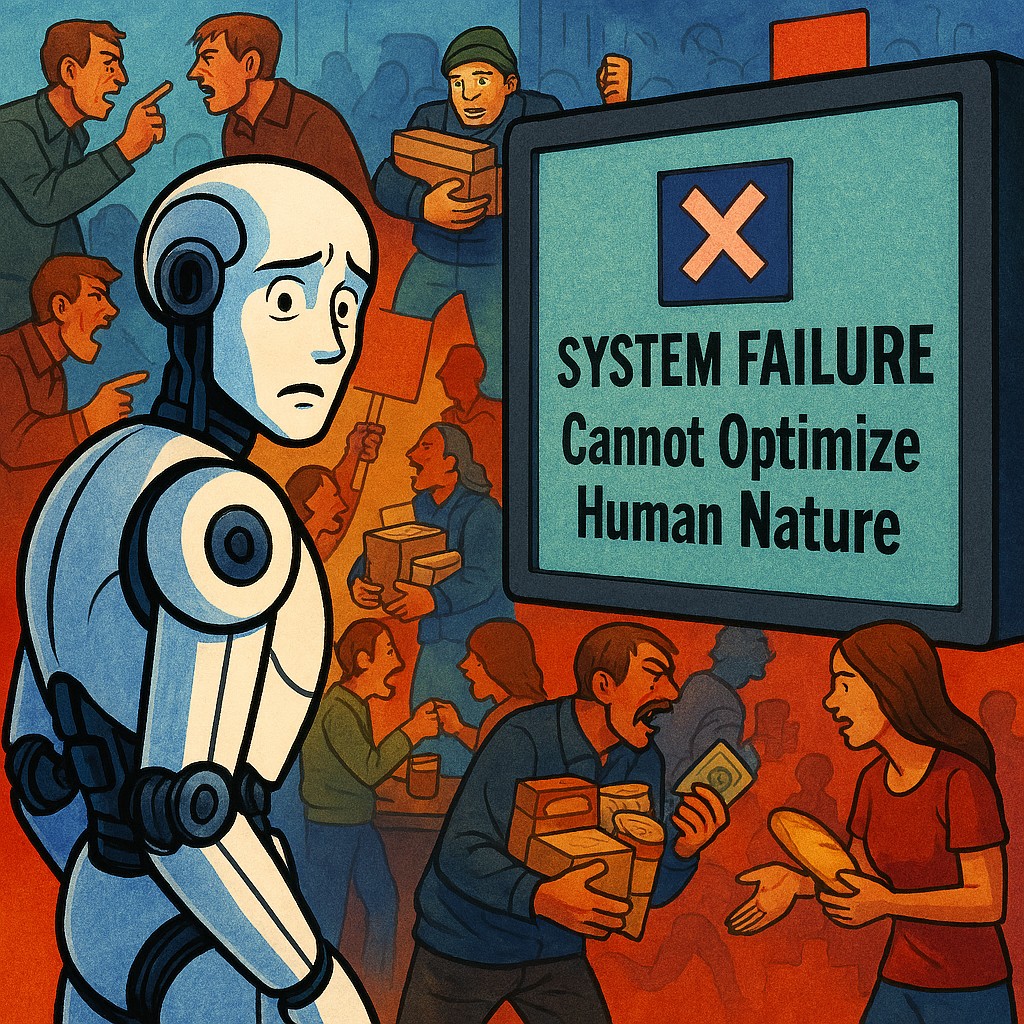
There is a growing belief that artificial intelligence and robotics will soon usher in a post-scarcity world where money becomes meaningless, work disappears, and everything from food to housing is free. Elon Musk and others have suggested that advanced AI paired with humanoid robots like Optimus will make labor obsolete and create “universal high income.” In theory, machines will produce everything, scarcity will vanish, and humans will be liberated from economic necessity. It is a crazy idea that makes the mistake of ignoring human nature.
The “super abundance” theory rests on four assumptions. First, that AI and robots will automate nearly all labor, physical or otherwise. Second, that automation will reduce production costs to near zero. Third, that abundance will eliminate scarcity and therefore render money obsolete. Fourth, that human behavior will adapt smoothly to this new reality. It sounds like a silly joke that ignores how people actually behave.
Resources and land on this Earth are finite. Even if robots could build houses cheaply, the land beneath those houses is unequal in desirability. A suburban or rural property on several acres will never be equivalent to a small urban apartment. Not everyone wants to live in a city or a suburb. Humans differ in how and where they want to live. Scarcity does not disappear by waving a magic wand. When everyone wants beachfront property, a robot or an AI cannot create more of it.
Historical Sidebar — What the Past Says About “Post-Scarcity”
- Predictions that technology would eliminate scarcity and work are not new. During the Industrial Revolution, mechanization reshaped economies but did not end scarcity or make human labor obsolete. New machines transformed production, but humans remained central to economic life and power remained concentrated in capital owners and governments.(Encyclopedia Britannica)
- Reform attempts to reduce working hours began long before AI. For example, the Factories Act of 1847 in the United Kingdom limited textile mill workers to 10-hour days, reflecting struggles over labor conditions rather than the end of work.(Wikipedia)
- Scholars emphasize that technological change historically redistributes labor rather than eliminates it. While automation has reduced the share of labor in some tasks, new jobs and industries have emerged, and the total number of jobs has generally grown with economic expansion.(McKinsey & Company)
- The idea that central planning or post-scarcity visions can replace market mechanisms is rooted in post-scarcity theory, long associated with Marxist thought about communism. Historical attempts at large-scale central planning, such as the Soviet model, suffered chronic shortages and misallocation because planners could not replicate the decentralized price signals of markets.(Grokipedia)
Across history, technology has lowered some costs and made certain goods cheaper or more accessible. But scarcity itself has never vanished, and economic systems have continuously adapted. Machines changed how work was done, not whether work existed. Scarcity might shift forms, but it has never disappeared from human affairs.
The above information is generated by ChatGPT
Money exists because scarcity exists. As long as something is limited and desired, it will have value. Eliminating money would require eliminating scarcity itself, which would require abolishing private ownership. That path has been tried before. It ends the same way every time. Totalitarianism, famine, and death.
Free or near-free housing cannot exist without centralized control. Someone must decide where housing goes and how conflicts are resolved. That power already belongs to governments. The theory claims AI will assist government in determining the perfect place to build, how large housing needs to be, and how many units are required. If a single person wants a three-bedroom house in the country and land is supposedly free, who decides whether that is acceptable and where it can be built? If the answer is an algorithm, it will reflect the biases of the people who programmed it.
When AI allocation replaces markets, rationing will follow. Rationing produces black markets, corruption, and coercion. It also creates black market money. People will barter for what they want or need. Barter, while quaint, is a step backward from the efficient exchange that money provides, even if that money takes the form of government-issued coupons.
The greatest flaw in the “super abundance” theory is the assumption that human behavior will change quickly enough to match technological progress. Western societies already live in conditions of unprecedented abundance by historical standards, yet depression, addiction, nihilism, and self-destructive behavior are rampant.
When humans do not struggle to survive, they do not automatically become enlightened creators. They become bored, resentful, and unstable. You cannot automate or regulate a human’s purpose in life. A society that removes work without replacing purpose creates decay.
The idea that AI can neutrally allocate resources ignores the fact that AI inherits human bias. Emotion is a variable that cannot be optimized. Many people will reject algorithmic authority outright.
The push toward synthetic biology as a replacement for natural food reveals another blind spot. Humans evolved eating real food. Beef from a cow is nutritionally dense, highly bioavailable, and metabolically compatible with human biology. Lab-grown meat, to date, has failed to match what nature provides. Studies over the years have shown that humans do not absorb nutrients from fortified foods the same way they do from whole foods.
Even if AI increases productivity, ownership of property will still matter. Those who control AI infrastructure, energy, land, and materials will exert control over their domains. Capitalism does not dissolve with automation, and governments do not relinquish power when scarcity decreases. Government has never met a moment where it did not invent new reasons to regulate. Look at what is happening with campaigns against beef, energy use, speech, and personal behavior in Europe and the United States.
Predictions that AGI (Artificial General Intelligence) and a post-scarcity world will arrive within decades ignore human history. The Industrial Revolution took over a century and involved mass suffering. The internet transformed communication but did not eliminate inequality, money, or power struggles. AI will follow the same pattern. Progress rarely comes without pain.
If AGI is possible, and if we avoid another world war in the near future, humans still will not change enough for this “super abundance” world to exist for at least 100 years, if ever.
AI and robotics will increase productivity. They will make some goods cheaper. They will disrupt some labor markets. They will change how humans live. What they cannot and will not do is abolish scarcity, eliminate money, or override human nature. Any system that claims it can do so requires either authoritarian control or magical thinking.
Utopias fail because they overestimate people. Human nature cannot be overridden by technology. That is why “super abundance” will only remain a thought experiment.
Ironic note: This post was created through a back-and-forth conversation using Grok. I had it synthesize that conversation into a blog post, which I then edited to remove words I would never use and to make it sound like something I would actually write. I then fed that version into ChatGPT to tighten it up and edit for grammar, punctuation, and clarity. This is an example of how LLMs (Large Language Models) are useful for tasks like these. I do not believe they are true AI as the term was originally defined.
They are better described as probability machines that guess what word comes next based on the data they were trained on.