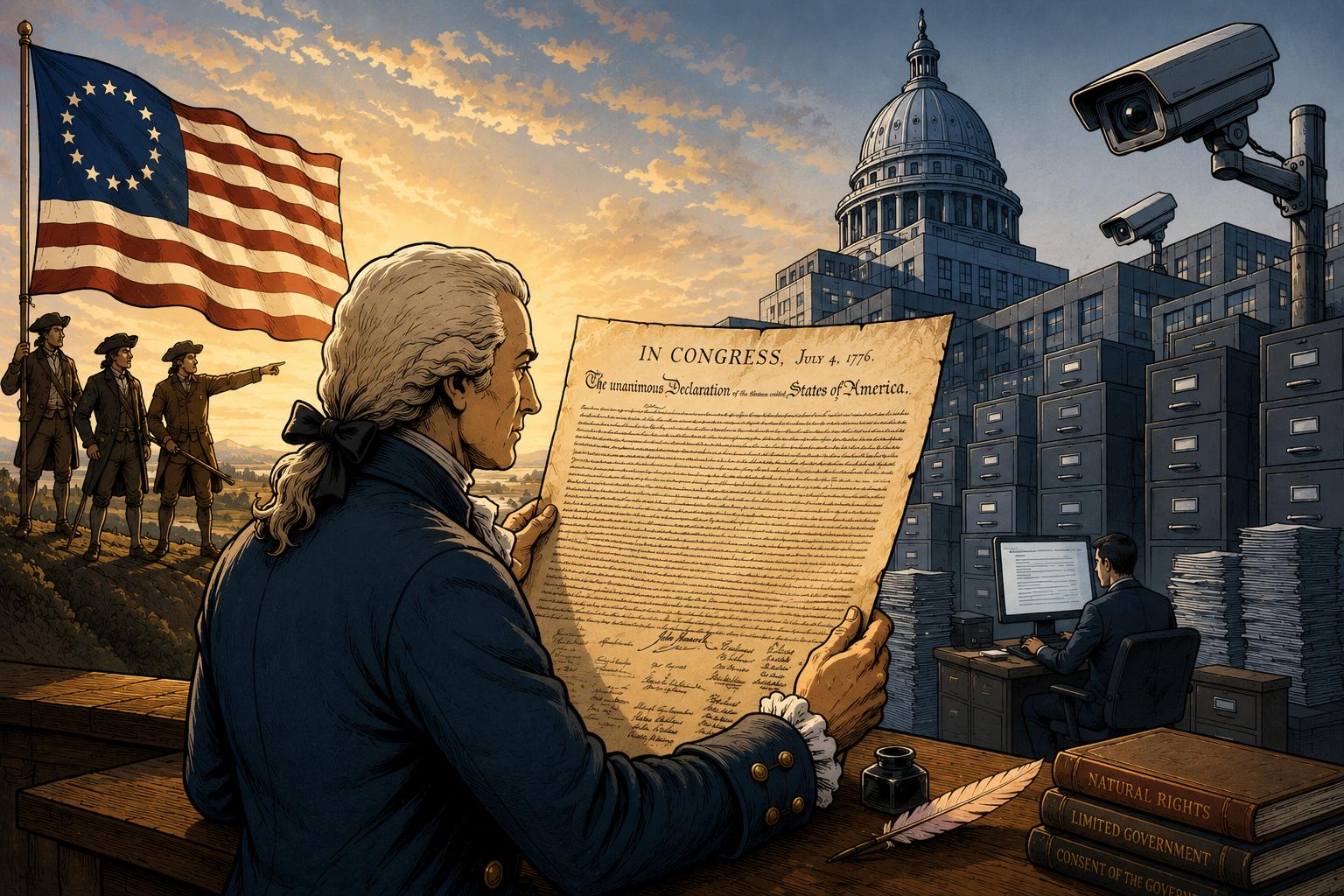
This July 4th, Americans celebrate the 250th anniversary of our independence. Our country is young. It’s odd to think that my life, at age 59, represents almost 24% of the entire existence of the United States. While other nations and civilizations date back thousands of years our country is but an infant by comparison. Millions will gather for barbecues, watch fireworks, and wave flags. All of this is part of the American experience. Through all this celebration, though, we as a nation need to re-engage with the document that made that independence possible. The Declaration of Independence is one of the most important political documents ever written, yet we tend to overlook the ideals that gave those words their meaning.
The Declaration was more than a formal announcement that the colonies intended to separate from Great Britain. It was a thorough explanation why that separation was necessary. Our founders’ argument rested on the principle that individuals possess rights that exist independent of government. Governments do not create those rights, grant those rights, or define those rights. Governments should exist to secure them. Government is not the source of freedom itself. That distinction formed the foundation of the American experiment.
The founders also placed the individual at the center of political life. The Declaration does not discuss the rights of groups, classes, or collectives. It speaks about the rights of people. They understood that governments always seek more authority and that concentrated power eventually threatens liberty regardless of who exercises it. They believed government required limits because human nature does not change. They built the case for independence around consent, accountability, and restraint. They viewed these principles as safeguards against the tendency of every government to expand beyond its intended role.
The list of grievances against King George III reveals how the founders distrusted unchecked authority. They complained about growing layers of government officials, rulers who operated beyond accountability, and decisions imposed on people without their consent. Those concerns, in some respects, have returned in modern forms. Americans now live under a vast administrative system that writes and enforces thousands of rules and regulations affecting daily life. Most of us can’t even identify the officials responsible for those rules, much less remove them from office. Government agencies have the ability to monitor movement and collect information on a scale the founders could never have imagined. Cameras record our travel through airports, license plate readers track vehicles across public roads, and surveillance systems create detailed records of ordinary activities. Each program arrives with a practical justification, yet together they represent an accumulation of power that would have alarmed a generation that had just fought a revolution against unaccountable authority.
The greatest concern is not any individual policy or political party. It is the gradual shift in how Americans view their relationship with the state. The founders believed government derived its authority from the consent of the governed and existed for a limited purpose. Modern political debates often begin with the assumption that government should solve every problem, manage every challenge, and assume new responsibilities whenever circumstances change. Each expansion is cloaked in compassion. Many people have been trampled by the boot of government compassion. Over time, each expansion moves political power farther from the individual and closer to institutions that face less direct accountability.
The approaching 250th anniversary provides an opportunity to revisit the principles that launched our nation. America should strive to live up to the ideals expressed in the Declaration of Independence. Rights belong to individuals. Government exists to secure those rights. Power requires limits because people cannot be trusted with unlimited authority. Those principles justified independence in 1776, and they remain just as relevant today. As we celebrate our nation’s birthday, we should spend a few minutes reading the document that started it all. I still believe what it says and you should too.