There were a couple articles in the Wall Street Journal today that once again sparked my interest in the way employment and unemployment is measured and reported. The way these numbers get reported seems to purposely obfuscate the true state of employment in the United States.
Here’s a bit of the first article about adding 130k jobs:
The U.S. economy added 130,000 jobs in January, its strongest growth in over a year, and a sign that the labor market may be shaking off its recent stagnation.
January’s robust gains surprised forecasters, blowing far past consensus expectations, while solidifying expectations the Federal Reserve will keep rates on hold for the foreseeable future. The unemployment rate dipped to 4.3% from 4.4% in December, the Labor Department said Wednesday. And workers’ wages rose.
The gains were highly concentrated in healthcare and social-assistance fields, which includes jobs like home health aides and residential care workers. Such jobs tend to grow regardless of the economy’s health and have long been an engine of U.S. job growth.
The Wall Street Journal (free link)
Here’s a bit of the second article about how previously reported numbers were adjusted:
The government has dramatically lowered its estimates for how many jobs the economy generated over the past two years.
The Labor Department’s Bureau of Labor Statistics on Wednesday said that the U.S. added just 1.5 million jobs in 2024, well below the previously estimated 2 million. In 2025, it said the labor market added only 181,000 jobs, versus the previously estimated 584,000.
Two separate revisions are mainly at play.
First, the Bureau of Labor Statistics released its annual “benchmark” revision, which accompanies each year’s January employment report and which revises job-growth estimates for the year ending the previous March. Wednesday’s revision showed there were a seasonally adjusted 898,000 fewer jobs previously reported.
Second, the BLS adjusted the methodology it uses to estimate how many businesses open and close each month, which affected job figures for the remainder of 2025.
The Wall Street Journal (free link)
The unemployment rate is the most quoted number in America. And there are two versions. U-3 and U-6. Economists use these numbers to debate whether the labor market is strong or weak. I think we are looking at the wrong number.
The official unemployment rate from the Bureau of Labor Statistics measures the percentage of people actively looking for work who can’t find it. That definition is published by the BLS. The U-3 number excludes anyone who has not actively looked for work in the past four weeks. Retirees, stay-at-home parents, students, and discouraged workers are not counted.
U-6 expands that definition by adding marginally attached workers and people working part-time who want full-time work. It’s better, but is still built around labor force participation rules.
I prefer the prime-age employment-to-population ratio. This measures the percentage of people ages 25 to 54 who actually have a job. The number simply counts if are you working or not. This is also published monthly by the BLS and available publicly through the Federal Reserve data system.
Right now that number is around 80 to 81 percent. We seemed to have peaked in the late 1990s at roughly 82 percent. But, this shows that today, employment among working-age adults is strong and near historical highs. A larger share of prime-age Americans are working today than during most of the past forty years.
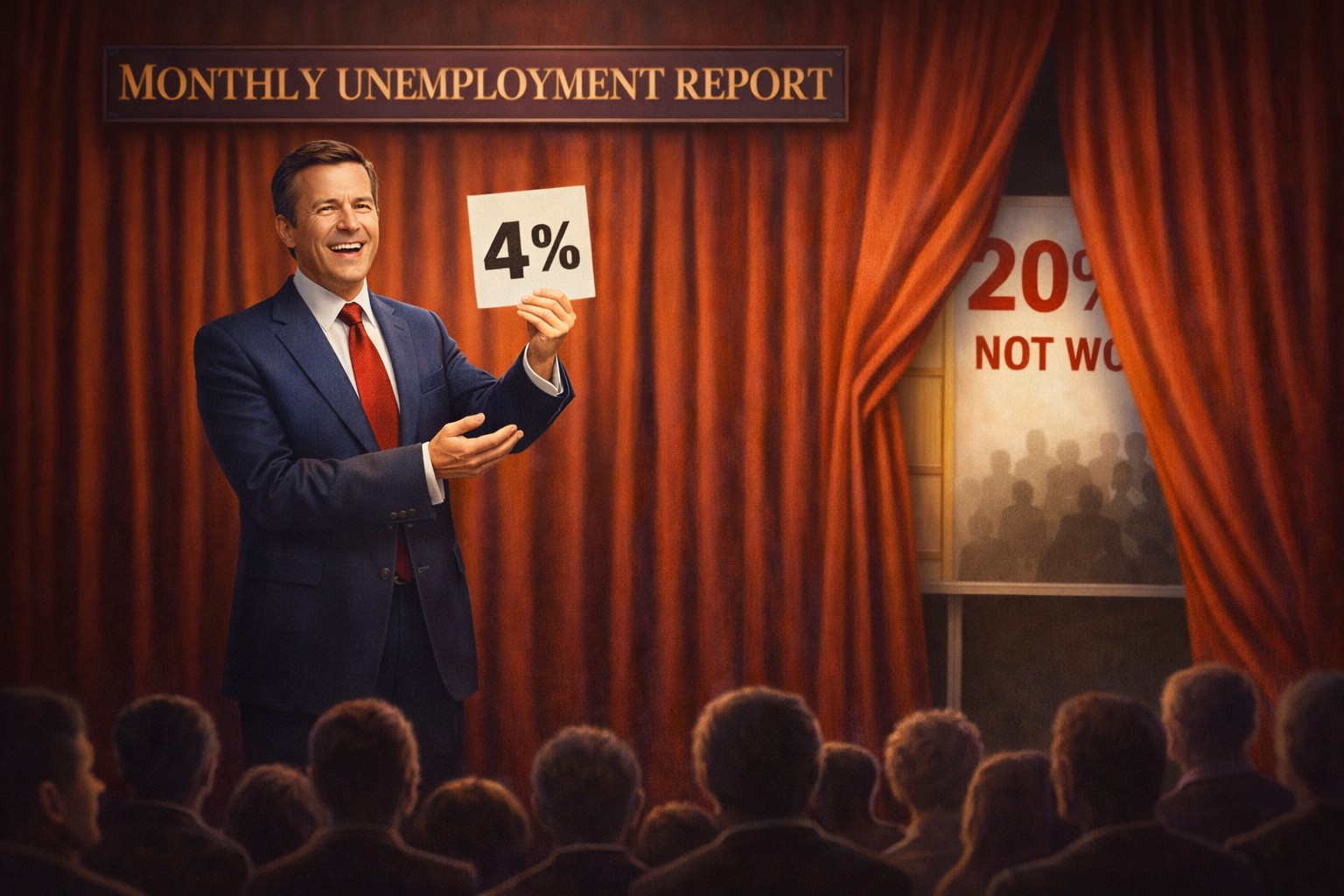
But if this number were published the federal government would also have to report an unemployment number that is much higher than the official unemployment rate. The prime-age unemployment rate would be around 20 percent That is way above the reported 4 percent U-3 rate. I believe this is why we don’t use the more honest number. People would be shocked by seeing a 20 percent unemployment rate
When you use the prime-age employment rate there is no redefinition of who is actively looking (whatever that means) or people who are not in the labor force. You just count how many prime working-age adults are… working.
Using this method, even accounting for people who hold multiple jobs doesn’t change the picture. The current payroll survey counts jobs and can double count jobs because of people with two positions. The prime-age employment rate, though, is based on the household survey and counts only people, not jobs. A person with two jobs counts only once. The BLS also publishes the multiple-jobholder rate.
I think reporting in this manner would be a boon to the current administration and even make Biden’s administration look good because prime-age employment IS near all-time highs. Right now the standard unemployment rate understates the share of working-age Americans who are not working. It only counts those actively searching and excludes a huge (yooj if you will) segment of the population that could work but is not.
If our goal is to understand the state of employment in the United States, the prime-age employment-to-population ratio is a cleaner jumping off point than U-3 or U-6.
I’m sure all the analysts and economists out there who regularly read my blog (this sentence is clear satire) would agree that we should report the prime-age employment rate and analyze the health of our labor market from there. There is no more clear metric available.