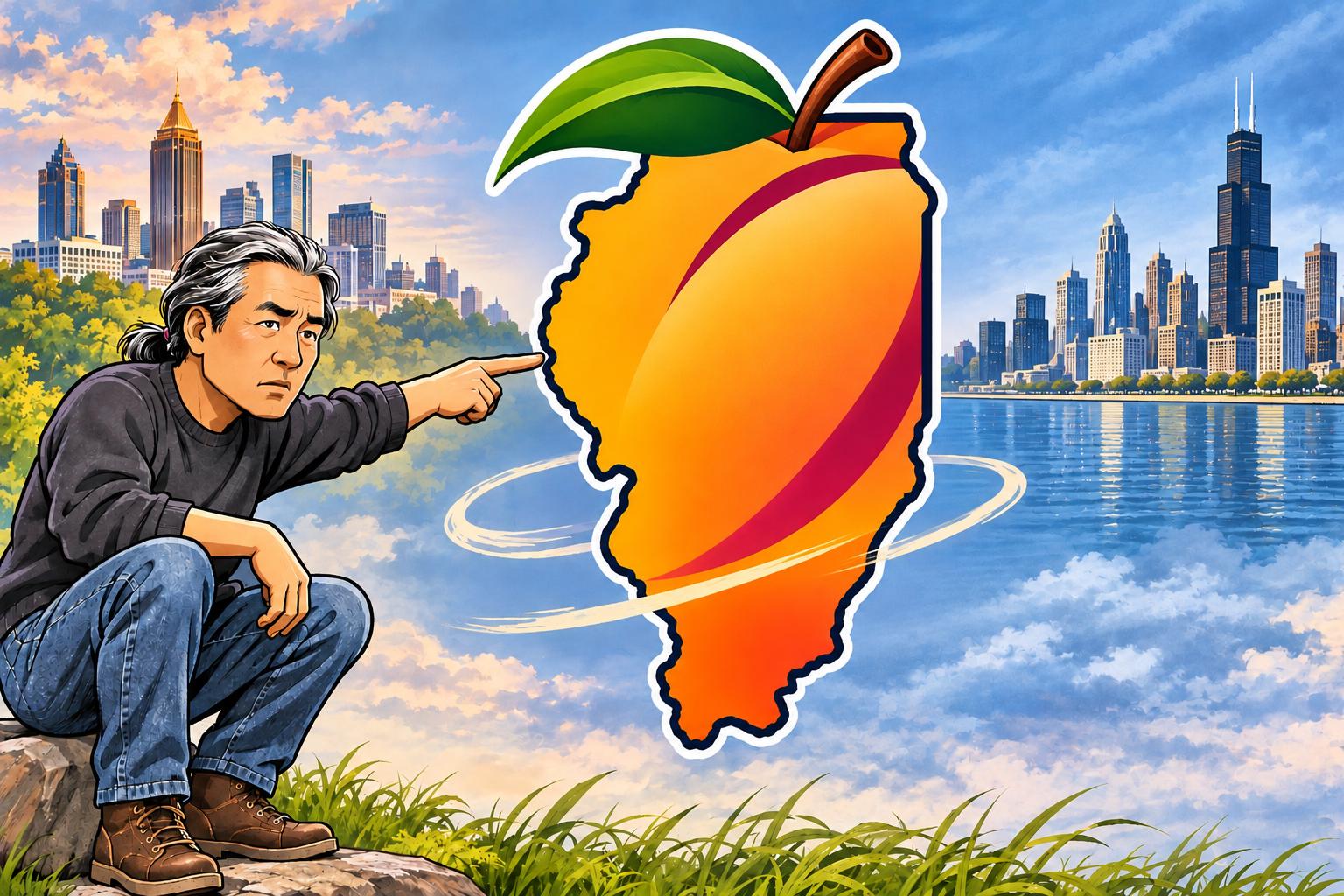
I recently read an editorial in the Chicago Tribune, and it posed a question to the Illinois Republican Party, “What’s smaller than a superminority? A super-duper-minority?” The Trib went on to say there’s “barely a Republican Party left north of I-80,” and it told Republicans they “now have to think in decades.” Here, where I’m living in Georgia, the state’s Republicans just got their own asses handed to them. I have seen this movie before. I think it was called Democrat Endgame.
On November 3, Georgia Democrats swept every statewide office on the ballot. Keisha Lance Bottoms, the disastrous former mayor of Atlanta, won the governor’s race. Jon Ossoff won a second Senate term. Democrats flipped the Georgia House of Representatives after decades of Republican control. Republicans did hold on to the state Senate, but by a thin margin.
The reaction I see online from hardcore Georgia Republicans is worse than the results of the election. They blame Governor Brian Kemp and Republican moderates. They call anyone who voted for Kemp a RINO and want them purged from the party. I heard the same thing in Illinois for twenty years, and the people who said it now live in a state where their party can’t win a single statewide race and can’t stop a single bill from advancing in Springfield.
I’m from Chicago, Illinois
I was born and raised on the north side of Chicago. Logan Square was my stomping grounds. In 1988 I moved to the burbs and bought a house in Glenview, a suburb on the North Shore of Chicago. I lived there for more than 30 years. When I moved to Glenview, it was Republican territory. The Republicans who represented it were fiscally conservative and relatively liberal on social issues.
In 1988, Glenview’s congressman was John Porter, a moderate Republican who held the 10th Congressional District from 1980 until he retired in 2001. Mark Kirk, another moderate Republican, replaced him and held the seat until he won a U.S. Senate seat in 2010. Bob Dold, a Republican, won the 10th that same year. In Springfield, Republican Beth Coulson of Glenview represented the 17th Illinois House District from 1997 until 2011.
Then the ground shifted. When Coulson left the seat to run for Congress in 2010, Democrat Daniel Biss won the 17th House District, only two years after he lost to her by about 1,500 votes. In 2011, Democrats controlled the governor’s office and both chambers of the General Assembly, so the great gerrymandering began, and they drew the new maps by themselves. They moved most of Glenview into Jan Schakowsky’s 9th Congressional District, a seat that mostly represented Evanston and Chicago’s north lakefront, and they drew Dold’s own Kenilworth home into her district too. Dold lost his seat in 2012.
The voters changed as well. New residents moved into Glenview and up and down the North Shore, and in my experience a lot of them came from places like California and voted for the same policies they had moved away from. The moderate Republican suburbs I moved to in 1988 turned into Democratic suburbs, and the Democrats they elected drifted further left every cycle. That shift did not stop at the Cook County line. It rolled through DuPage, Lake, Kane, Will, and finally McHenry, the last collar county Republicans could count on.
Illinois Republicans went from impotent to irrelevant
People forget that Illinois was a competitive state within my adult lifetime. Republicans held the governor’s office for 26 straight years. Here is how they lost it all.
1977 to 2003: Republicans Jim Thompson, Jim Edgar, and George Ryan hold the governor’s office for 26 consecutive years. George Ryan’s corruption scandal at the end of that run kills the Republican brand, and a federal jury convicts him in 2006.
1991: Illinois breaks redistricting deadlocks by drawing a name out of a hat. Republicans win the drawing and draw the legislative map for the decade. You might think they would have done a better job.
1995 to 1996: Republicans control the governor’s office, the Illinois House, and the Illinois Senate. Nobody knew it at the time, but this is the last Republican trifecta in Illinois.
1996: Democrats win back the Illinois House. Michael Madigan returns as Speaker and holds the gavel until 2021.
2001: Secretary of State Jesse White pulls the name of a Democrat, former state Supreme Court Justice Michael Bilandic, out of a stovepipe hat. Democrats get to draw the legislative map. This closes the coffin lid on the Republicans.
2002: Rod Blagojevich becomes the first Democrat elected governor since 1972, and Democrats take the Illinois Senate on the new map. The Democratic trifecta begins in 2003.
2007: Senate Democrats reach a supermajority of 36 or more seats, enough to override a governor’s veto without a single Republican vote. They slip to 35 seats after the 2010 election and win the supermajority back in 2012.
2009: Governor Rod Blagojevich is impeached and removed from office. But somehow that didn’t taint the Democrat brand among Democrats.
2010: Rod Blagojevich is convicted of lying to the FBI. The Democrat brand still remains untainted for Democrats. The national red wave sends Mark Kirk to the U.S. Senate, carried by the collar counties, and Bob Dold to Congress. At the same time, Glenview’s own state House seat flips to Democrat Daniel Biss.
2011: Rod Blagojevich is convicted of trying to sell Barack Obama’s Senate seat, and the Democrat brand still survives under Democrats. Democrats draw both the congressional and legislative maps with no Republican input, and Gov. Pat Quinn signs them.
2012: The new map results in seats flipping left and right. Republican Reps. Joe Walsh, Bob Dold, Judy Biggert, and Bobby Schilling all lose, and Democrats win veto-proof majorities of 71 to 47 in the House and 40 to 19 in the Senate.
2014: Bruce Rauner, by some miracle, wins the governor’s race. He spends four years in a standoff with Madigan’s supermajority, and the state goes two years without a full budget.
2016: More than 563,000 Illinois voters sign petitions for an independent redistricting commission. The Democrat-controlled Illinois Supreme Court strikes it from the ballot on a 4 to 3 party-line vote. That November, Hillary Clinton carries every collar county except McHenry, and Kirk loses his Senate seat to Tammy Duckworth.
2018: JB Pritzker beats Rauner. Republican Reps. Peter Roskam and Randy Hultgren lose their suburban seats, leaving the GOP with no members of Congress from northeastern Illinois. Roskam won by 18 points in 2016 and lost by 10 two years later.
2021: Pritzker signs Democrat-drawn legislative maps after promising as a candidate in 2018 that he would veto any map drawn by legislators or party leaders.
2022: According to the Tribune, Republican Illinois House candidates win about 51% of the votes cast and only a third of the seats. Forty of the 118 House races go uncontested, many of them because the Republican Party doesn’t bother fielding a candidate in districts the map has already decided.
2024: Democrats win 55% of Illinois House votes and 78 of 118 seats, a supermajority.
2026: Democrats gain at least seven more seats in the General Assembly. Even McHenry County, which Rauner won by 10 points in 2018, votes for Pritzker.
The pattern is crystal clear. Republicans lost the suburbs one election at a time over 20 years, and once Democrats held the governor’s office and both chambers at the same time, they used the maps to lock it in. The Tribune’s description is spot on, “Red waves nationally barely move the needle for Illinois Republicans. And blue waves, like the one we witnessed Tuesday, wash them out to sea.”
Who’s left in Illinois
The Illinois Republican Party that exists today lives almost entirely in rural downstate counties. Those counties have land and cows and very few voters. The party there is loud, angry, and has no power. Democrats win every statewide race and have gerrymandered the Republicans into a tiny group of screaming ninnies who hold press conferences about bills they can’t stop.
The hardcore Republicans in Illinois got exactly what they asked for. They ran the moderates out, and the moderates took their votes with them. Some of those voters, like me, left the state, and the ones who stayed Republican stopped bothering to show up. The purists won control of a party that can’t win anything.
Georgia is making the same mistakes
I see the same thing starting here. The hardcore wing demonizes the moderates, pushes the most conservative candidate in every primary, and then acts surprised when that candidate can’t win over moderate Republicans. Most voters sit in the middle. Republicans can’t write off the middle if they hope to win or keep a majority.
There is a reason Brian Kemp won two terms. He knew how to hold the conservative base and still appeal to the suburban voters around Atlanta. I agree with his record on fiscal discipline, growing the economy, and keeping taxes low. So did enough Georgians to keep him in office through two elections.
My biggest disagreement with Kemp is from the 2020 election. Georgia hand-counted nearly 5 million presidential ballots, but a recount only counts every ballot again and can’t tell you whether the ballots were legitimate. State investigators fielded individual complaints and audited signatures on a tiny 10% sample of absentee envelopes in one county, Cobb, and the state never ran a statewide signature audit. When investigators later confirmed that Fulton County scanned more than 3,000 ballots twice during its recount, the State Election Board reprimanded the county but declined to refer the case for further investigation. I never saw the concerted fraud investigation those questions deserved.
Kemp was term-limited this year, and the party allowed Rick Jackson to defeat the more moderate Burt Jones. Personally, I didn’t care for either candidate, but I knew either one would be better than the Democrat governor-elect. The Atlanta Journal-Constitution reported after the election that Democrats flipped counties Trump carried by double digits just two years ago. Georgia Republicans now face a choice between doubling down on being hardcore Republicans or returning to a more moderate brand of conservatism that elected Kemp. The people I see posting online seem to have picked the road to political impotence.
Strap in for new legislative maps in 2031
Georgia still has time. The governor and legislature Georgians elect in 2030 will draw the political maps after the 2030 census. Democrats now hold the governor’s office and the state House, and Republicans hold the Senate by a narrowing margin. If Democrats win all three by 2030, they will draw the lines for the 2030s, and Georgia Republicans will learn what it feels like to be an Illinois Republican.
The Tribune’s advice to Illinois Republicans is the same advice that Georgia Republicans should heed. Recruit competent candidates who run on fiscal discipline, and purge the hardcore voices at the fringes that isolate the people in the middle. Georgia Republicans still have a far better position than their Illinois counterparts. They hold the state Senate, the Kemp brand is still very strong, and Georgia is still more red than it is blue. There is time to fix this.
What happens next
If the hardcore Republicans keep this up, they won’t recognize their state in 10 years. The people demanding purity tests and purges right now do not want to live in a one-party Democrat state. I lived it and it’s not pretty. The Democrats write every law, draw every map, and set every tax rate while the super-duper-minority continues tilting at windmills. Will Georgia Republicans learn from the lessons of Illinois? History tells me… No.
Leave a Reply