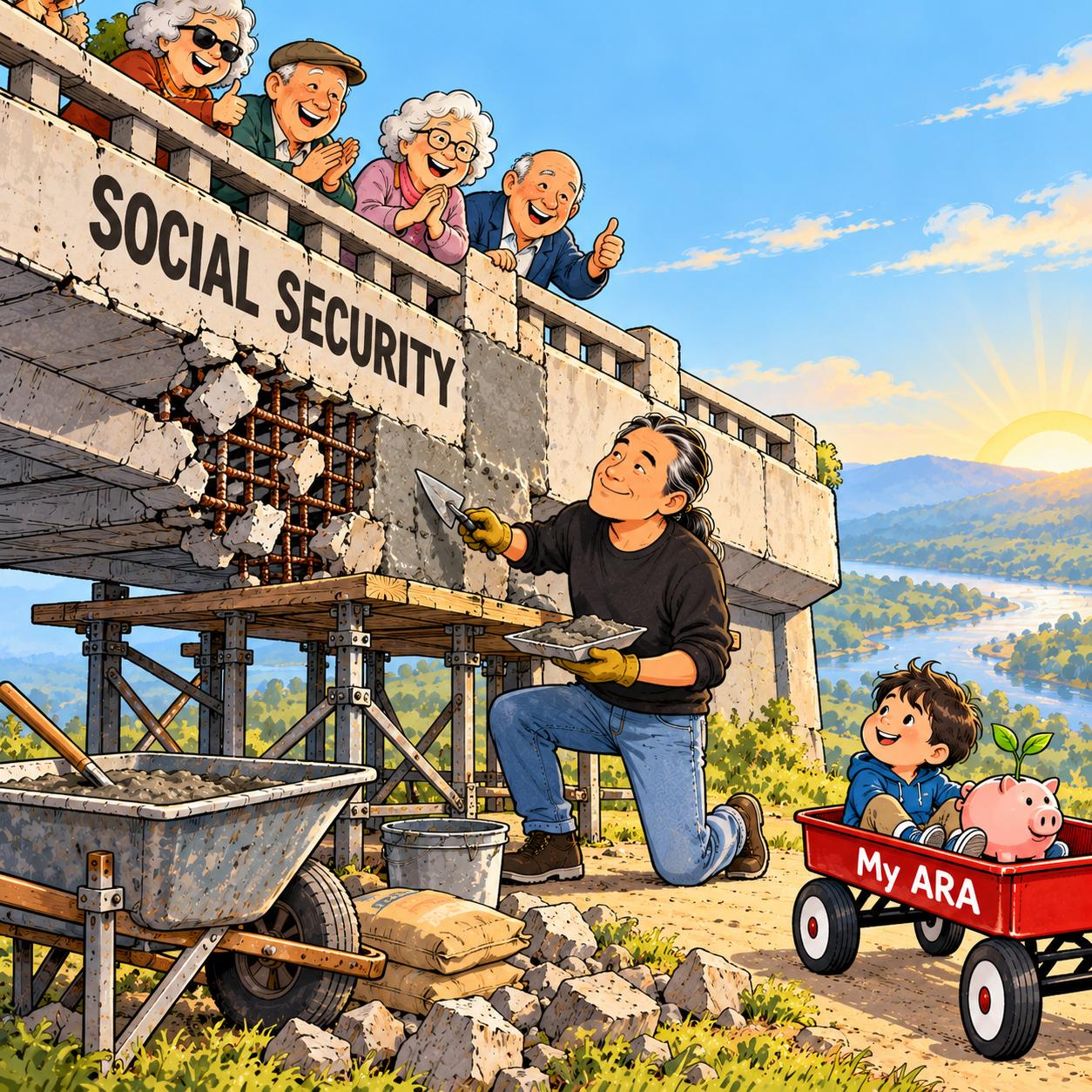
Social Security runs dry in the fourth quarter of 2032, or so they say. At that point, current law cuts the benefits by 22% for every retiree in America. Congress hasn’t done shit about it for decades.
But there is a slightly rosier number if you combine the “retirement fund” with the “disability fund”, (funds in government speak is honestly just a budget line item). Then the depletion date moves to 2034 with only a 17% cut in benefits for every retiree… so we got that going for us. This assumes Congress lets the two funds share money, which the law does not allow. That leaves us with the retirement financial apocalypse in 2032. Just a mere six years away.
So I fixed it for ya. Noodling around with my AI buddy, I came up with a nifty three-part plan. It keeps Social Security paying full benefits to the people already in it, sets a hard date to stop adding new people, and replaces it with a retirement account that each person owns outright. There’s a little bit of pain in it for everyone, but, it ends the problem for good.
Social Security pays today’s retirees with today’s employees’ payroll taxes. Social Security paid out $1.6 trillion in benefits in 2025, funded mostly by the 185 million people who paid payroll taxes. Payroll tax revenue has fallen short of the program’s costs every year since 2010. It all happened because Congress created one of the world’s largest pyramid schemes.
Any scheme that pays early participants with money from later participants works only while the base of new participants keeps growing. Hence the pyramid moniker. In 1950, 16.5 people paid into the system for every person collecting benefits. In 2025, the number was 2.6.
Part one: keep the promise to the people already in it
The payroll tax stops at $184,500 of wages for 2026. A person earning $184,500 and an person earning $20 million pay the exact same Social Security tax, $11,439 each. Take away the cap until Social Security ends. The newly taxed wages count toward benefits under the existing formula. Social Security’s own actuaries estimated in 2021 that removing the cap this way would close 57% of the program’s 75-year shortfall and push depletion from 2034 to 2054. Just like that, we solve a big chunk of the problem.
Increase the full retirement age from 67 to 70, one year every two years: 68 in 2028, 69 in 2030, and 70 in 2032. Early retirement at 62 goes away. Cost-of-living adjustments stay as they are, and so does the benefit formula. Retirees keep the inflation protection they have now, and nobody’s benefit gets recalculated downward. The pain points are that high earners pay more tax, and everyone still in the system waits longer to collect.
The $255 lump-sum death payment also goes (I didn’t even know this existed). Congress set it at $255 in 1954 and has never raised it. It covers a fraction of a basic cremation. This program’s usefulness has long expired.
Part two: set an end date
On January 1, 2031, Social Security stops taking new members. Anyone born in 2031 or later never enters the program and never pays its tax. Everyone under 40 on that date, including kids who haven’t started working yet, moves into the new system by default. They keep the Social Security credits already earned as a frozen benefit paid at retirement. Anyone under 40 who would rather stay in the current program can file to stay. People 40 and older stay where they are.
Sweeping the under 40 is the default because an opt-in program wouldn’t move as many younger people as an opt-out program. Moving them early ends Social Security decades earlier. Under a birth-year cutoff alone, Social Security would pay its last legacy benefits sometime in the 2120s. Moving everyone under 40 shrinks the legacy obligation every year starting in the 2030s and ends it in the 2090s.
When young people stop paying into Social Security, the older people still collecting benefits need to get that money from somewhere. Here’s where my AI buddy helped me with a scheme to cover that: Legacy Bonds. These are long-term Treasury bonds issued for the purpose of paying the benefits Social Security promised to people in the old system. The government already owes those benefits, so the bonds convert an obligation it carries off the books into debt it carries on the books, but with a set payoff date. When the last Social Security check goes out, the bonds stop, and Social Security closes for good. The generation in the middle will have to carry the cost of paying for the old system while building the new one. That’s their pain point.
I would have to walk my talk. I turn 60 this year, which puts me smack dab in the group that carries the transition. Right now, full retirement age is 67, and I could start collecting reduced benefits at 62. Under my plan, early retirement disappears and I would have to wait until I turn 70 to collect, so I have to wait three extra years for my first check. Under Social Security as it exists, if I planned to wait until 70 anyway, I would get 124% of my full benefit because of delayed retirement credits. My plan pays 100% at age 70, which works out to about 19% less per month. Current law also carries the automatic cut that starts in 2032. My plan pays the full 100% at 70 with no automatic cut and all I have to do is give up three years of checks.
Part three: an account you own
Every child born in 2031 or later gets an American Retirement Account, or ARA, at birth, seeded with $1,000 courtesy of the U.S. taxpayers. It’s kind of like the Trump Accounts, and my plan will roll those balances into ARAs when the switch takes effect in 2031. Here are the rules on the ARA: no access until 65, no tax on withdrawals, and no cap on what individuals and families can contribute. Left alone at a 4% return after inflation, that $1,000 grows to about $12,800 in today’s dollars by age 65. With about 3.6 million births a year, funding these accounts will cost taxpayers about $3.6 billion annually, roughly 0.2% of what Social Security paid out in 2025.
In the new system, employees must contribute at least 5% of their gross wages into their ARA, deducted from each paycheck the same way Social Security tax is today. The contribution still counts as taxable income, just like a Roth 401(k), so the money goes in after tax and comes out tax free. People can contribute as much as they want, with no limit. Employers will no longer have to pay their 6.2% share of the Social Security tax for their employees. The retirement accounts invest in a short menu of low-cost index funds, the same model federal employees use in the Thrift Savings Plan.
Nobody can touch the accounts before age 65. No exceptions. No loans, no hardship withdrawals, and certainly no access for the government. At 65, the owner can withdraw any amount at any time, and every withdrawal is tax free. If you want to blow your wad on hookers and cocaine the moment you hit 65, more power to ya. However, taxpayers won’t bail you out if you do. If you’re smart, you’ll parcel it out into nice neat monthly withdrawals to cover your living expenses and healthcare needs until the day you leave the planet.
The principle behind the design is simple. Once income gets taxed, it should not get taxed again. A person who earned the money, paid tax on it, and locked it away for 40 or more years should not pay tax a second time on the returns. This is also why I would set no cap on contributions. Capping how much a person saves for their own retirement penalizes the people who save the most.
The money belongs to you
In writing this blog post, I learned that “your” Social Security benefits don’t belong to you. They are the property of the U.S. Government. The Supreme Court ruled in Flemming v. Nestor in 1960 that employees have no property right to their Social Security benefits and that Congress can change or cut them at any time. The 2032 cut written into current law is the proof in the pudding.
These private retirement accounts are personal property. The government cannot take them without inviting a challenge under the Fifth Amendment to the Constitution, which bars taking private property without just compensation. Congress could still try to change the tax treatment of withdrawals, and I expect they would. But at least the money, for some period of time, stays with the person who earned it.
Generational wealth from ordinary work
My plan has the potential to create generational wealth for the average citizen no matter where they start out in life. Consider what happens when someone dies early today. A single worker who dies at 60 after 40 years of payroll taxes leaves nothing behind. Even the $255 death payment goes only to a surviving spouse or a child already collecting benefits on the person’s record. Lower-income employees die younger on average, so Social Security moves money from people who die early to people who live long. Under this plan, a person can leave the entire account balance to their family.
Inherited balances roll into each heir’s own account and follow the same rules. The funds are locked until the heir turns 65 and tax free when withdrawn. The math works at any wage level. At a 4% return after inflation, a balance left untouched roughly triples every 30 years, so $100,000 becomes about $324,000 in one generation, $1 million in two, and $3.4 million in three. A family that works ordinary jobs and leaves the account alone can build wealth that compounds across generations.
The lock until 65 also keeps heirs working. A 35-year-old who inherits a parent’s account under my plan cannot live off it, so they keep working, keep contributing, and keep the country productive while the inherited balance grows alongside their own.
Short-term pain, permanent fix
Welcome to the ARA. My plan keeps Social Security running long enough to pay what it owes, then shuts it down. Every American born after 2030 retires on money they own, money that cannot go insolvent, money Congress cannot cut, and money they can leave to their children.
This will never pass. Number one, what member of Congress reads this blog and enjoys my genius? Number two, I bet Congress will wait until 2032, let the automatic cut hit, and then scramble to patch the program for another couple of decades. I leave this here anyway for posterity. Someone somewhere will read this and know that I found the solution… the right solution, first!
Leave a Reply