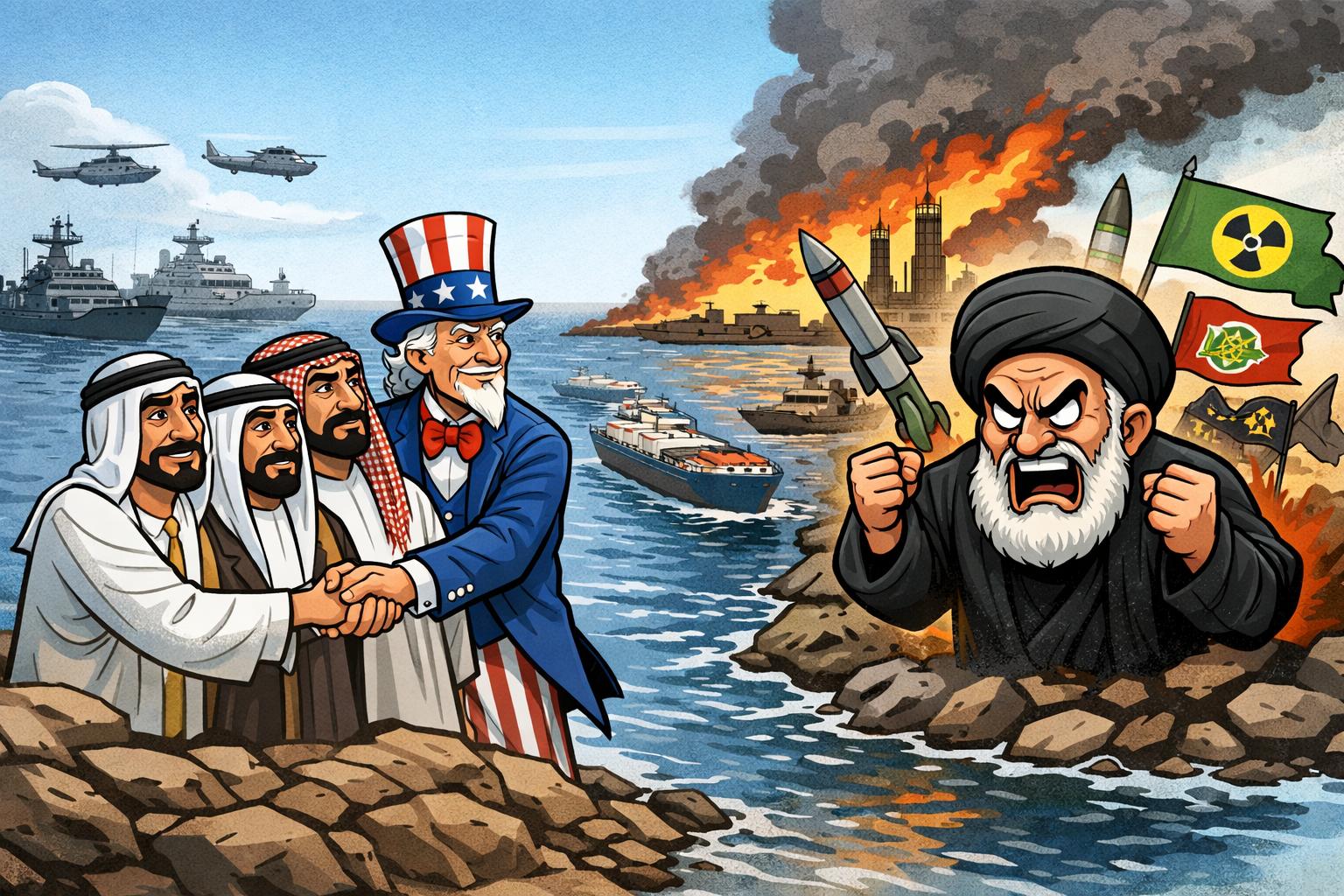
What’s happening in the Gulf is not normal. And it’s because of how events are unfolding and the identity of the active players. The significant part is which nations are no longer central to the equation.
For decades, the United States provided military force. Europe and the UK, because of their reliance on foreign sources of energy, reinforced that structure politically and, sometimes, militarily. Gulf states stayed cautious and largely avoided direct confrontation with Iran while they focused on building economic models around tourism and global integration. Everything changed when Trump launched the attack on Iran.
The United Arab Emirates no longer positions itself as a neutral intermediary. It is openly discussing operational roles in securing the Strait of Hormuz and aligning itself with the United States to continue pressure on Iran. Saudi Arabia is not defaulting to restraint. It is publicly signaling that the United States should continue its pressure on Iran until its capabilities are eliminated. It’s rare for Gulf nations to act and react in this manner.
The United Arab Emirates is preparing to help the U.S. and other allies open the Strait of Hormuz by force, Arab officials said, a move that would make it the first Persian Gulf country to become a combatant, after being hit by Iranian attacks.
The U.A.E. is lobbying for a United Nations Security Council resolution that would authorize such action, the officials said. Emirati diplomats have urged the U.S. and military powers in Europe and Asia to form a coalition to open the strait by force, the officials said. A U.A.E. official said the Iranian regime thinks it is fighting for its existence and is willing to bring the global economy down with it in a chokehold on the strait.
The U.A.E. official said the country had reviewed its capabilities to assist in securing the strait, including efforts to help clear it of mines and other support services.
The Gulf state has also said the U.S. should occupy islands in the strategic waterway including Abu Musa, which has been held by Iran for a half-century and is claimed by the U.A.E., other Arab officials said.
The Wall Street Journal
While Gulf nations are rising to the occasion, Europe and the UK are, by choice, remaining peripheral to the conflict.
An article in The Free Press describes a transatlantic alliance that no longer functions cohesively. European governments have condemned Iran, but they have refused to commit forces or participate in offensive operations, in some cases explicitly treating the conflict as “not their war.”
The problem is continent-wide. Despite condemning Iran’s actions, European governments have shown little appetite to help Washington, refusing to commit forces, ruling out offensive operations, and in some cases explicitly distancing themselves from what they describe as “not our war.” Trump has heard that message loud and clear.
Swedish Member of the European Parliament (MEP) Charlie Weimers shares Trump’s frustration at what he sees as an incoherent and risk-averse European Union (EU) response. “European leaders can’t have their cake and eat it too,” he said. “Either you want to remove the terrorist regime in Tehran, or you don’t.
The Free Press
Britain used to be a major naval power, but now operates with severely limited capacity relative to its past. The United States is not far behind. Across Europe, military readiness is constrained, and they cannot sustain operations without U.S. support.
Gulf states that traditionally avoided direct conflict are now moving closer to it. The NATO countries that once formed the backbone of collective military action are stepping back. A different structure is being created, centered on the United States and Gulf region partners who have immediate economic and security interests. This is the realignment.
The Strait of Hormuz is the central artery for Gulf economies and through which much of the Eastern Hemisphere’s energy flows. Control over its security directly affects energy, trade, and the broader economic model built around tourism, logistics, and finance. If Iran continues to exist in its current form, it threatens that artery and holds leverage over the entire region.
What follows from all this is a massive redistribution of power. The United States and aligned Gulf states may take primary responsibility for securing the region’s most critical infrastructure in a structural shift. Europe and the UK risk becoming mere observers, limited to diplomatic support and defensive measures. They will no longer have the ability to shape outcomes in the region. This would be an enormous shift from the post–Cold War model.
Instead of the NATO alliance projecting power into the region, the United States alone may provide overall security while Gulf states administer the infrastructure.
Gulf states seem keenly aware that it is no longer acceptable for Iran to retain its ability to threaten their economic interests. And the United States, right or wrong, is the only nation willing to take on this responsibility. Europe’s position reinforces this shift. By remaining outside the conflict, whether due to capacity constraints or political divisions, it cedes its influence in the region.
Is this the future of the Middle East? A model where the United States and its regional partners enforce the security of the Gulf while Europe and the UK remain on the outside looking in?
If this comes to pass, hopefully without much more loss of life on the American side, this might be the best thing to happen to that region in my lifetime. There could actually be peace in the Middle East, with UK and European powers no longer able to meddle in regional affairs.
I wasn’t in favor of Trump launching the attack on Iran, but we’re here. I’d rather see something good come of this, especially after so many Americans have been wounded or killed in this conflict over the last few weeks.